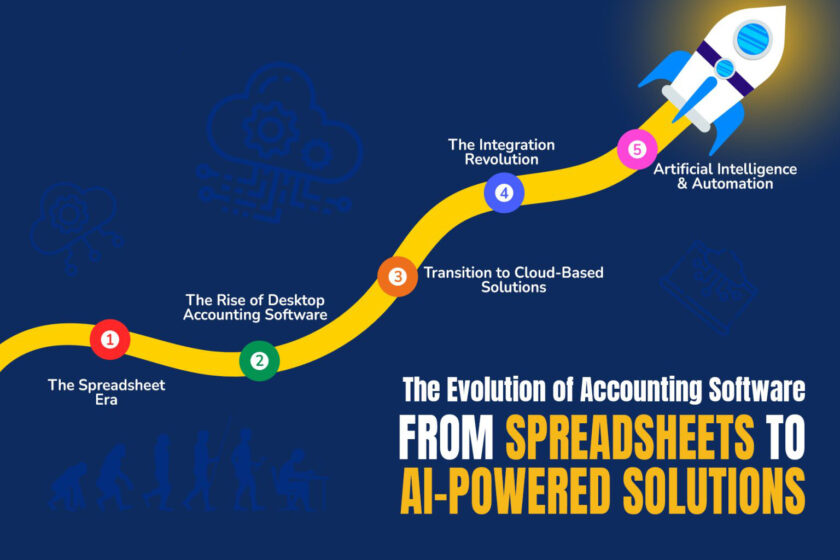
Accounting plays a key role in business choices, but the tools for managing money info have changed a lot in recent years. We’ve seen a shift from hand-written books to computer sheets then to desktop programs that work on their own followed by systems that use the internet, and now—platforms that think for themselves. Each step forward didn’t just bring new tech; it changed how companies work, team up, and get bigger.
As Malaysian companies move toward digital-first operations and processes driven by compliance like e-invoicing, they need accounting tools that work well, make few mistakes, and can handle growth. Knowing how these tools have changed helps businesses see what new accounting software can do—and why keeping up is now a must.
Accounting software started as hand-written spreadsheets then became desktop programs, moved to the cloud, and now uses AI. Today’s accounting software puts in data, works with payroll and HR systems, cuts down on mistakes, helps follow rules, and shows financial information right away so companies can make better choices.
From Spreadsheets to Software: How Accounting Tools Changed
1. When Spreadsheets Were King
Before computers took over, spreadsheets changed the accounting world. Programs like Microsoft Excel became popular because they let people do calculations, sort data, and make templates. Small companies liked spreadsheets because they were cheap and flexible compared to paper books.
But spreadsheets had problems. People made mistakes when typing in data, files got hard to manage as businesses grew, and working together often led to mix-ups. Even though spreadsheets were a big step forward, they were just the start.
2. Desktop Accounting Software Takes Off
As businesses needed better tools, they turned to desktop (on-premise) software. This new era brought in automatic entries built-in reports, and special features for different industries that made work much easier.
These systems improved accuracy and cut down on repetitive tasks. But they still had some problems:
- You couldn’t access them from outside the office
- You had to install and update them yourself
- Backing up data was tricky and working together was limited
They packed a punch—but couldn’t bend enough for teams that were growing fast or spread out.
3. The Move to Cloud-Based Options
Cloud computing turned accounting upside down. Instead of keeping data on one office computer, companies could now check their up-to-the-minute money info from anywhere, at any time.
This change brought huge perks:
- Updates happened on their own without stopping work
- You could log in from different devices even from home
- It grew with both small and big businesses
- Data stayed safer thanks to encrypted cloud storage
For instance, DigiSME Cloud Accounting Software enables businesses to handle invoicing, expenses, bank reconciliation, and project costing without concerns about losing files or using outdated versions.
4. The Integration Revolution
Today’s companies reject disjointed systems. Businesses now expect full ecosystem connectivity—where accounting connects to HR, payroll, CRM e-invoicing, and inventory.
Integration resolves several operational issues:
- It cuts down on manual data copying
- It ensures up-to-date information across departments
- It provides leaders with one reliable source of financial data
- It helps meet SST, LHDN, and e-invoicing rules
This linked approach has become the benchmark for forward-thinking SMEs in 2025–2026.
5. AI & Automation Transform Accounting
The newest wave brings AI-powered accounting systems that can learn, forecast trends, and handle complex financial jobs . These tools now do more than just record data—they make sense of it.
AI can now:
- Enter data from receipts and invoices
- Group items smartly getting better over time
- Spot fraud patterns
- Predict cash flow
- Create financial insights to help make decisions
For Malaysian companies getting ready for e-invoicing and digital tax reports, AI tools cut down on human mistakes and help follow the rules better.
These days new accounting systems can link up payroll without help, make reports ready for taxes, see how profitable projects are, and take care of routine tasks with almost no manual work.
Why This Change Matters to Today’s Businesses
As tech gets better, what businesses expect changes too. Companies now need more than just basic accounting. They want systems that are accurate, fast work with other tools, help follow rules, and give insights to grow.
Programs that work like old spreadsheets make teams slow, might cause mistakes, and make checks harder—with tough LHDN and e-invoicing rules.
New AI-powered accounting, like DigiSME’s Accounting Software, gives you:
- Quicker processing
- Higher accuracy
- Better rule-following
- Clearer money picture
- Less office work
And in the end: more time to plan for growth instead of doing the same tasks over and over.
Switch to Modern Accounting
If you’re still doing your books by hand or with old software, it’s time for a change. DigiSME’s Accounting Software combines cloud tech, automation, integration, and AI smarts—making it the ideal choice for Malaysian companies getting ready for digital rules in 2025–2026.